
UK Social Housing: All Your Questions Answered
Social housing, which includes asylum seeker accommodation, is becoming increasingly popular with investors who have become frustrated with the challenges of owning buy to let and HMO properties. Investing in the right property managed by one of the UK government’s largest social housing providers can offer stable returns, whilst mitigating against the rising costs associated with UK property investment. What exactly is social housing, how does it work and is it right for me as an investor?
What Is ‘Social Housing’?
The terms social housing and registered provider are defined in the Housing and Regeneration Act 2008:
‘Social housing includes low-cost rental (such as affordable rent properties) and low-cost home ownership. Registered providers of social housing include local authority landlords and private registered providers (such as not-for-profit housing associations, co-operatives, and for-profit organisations).’
Who Does Social Housing Provide Accommodation For?
For the purposes of this article, we will focus on the latter providers (for-profit organisations) providing housing specifically for asylum seekers.
According to the definition on refugee-action.org.uk, an asylum seeker is:
‘Someone who has arrived in a country and asked for asylum. Until they receive a decision as to whether or not they are a refugee, they are known as an asylum seeker. In the UK, this means they do not have the same rights as a refugee or a British citizen would. For example, people seeking asylum aren’t allowed to work.’
How Much Demand Is There?
According to figures published by the Office For National Statistics, overall migration to the UK in the year to June 2022 stood at 1.1m boosted by migrants from Afghanistan, Ukraine and Hong Kong. This resulted in net migration to the UK reaching a record high of 504,000.
With regard to asylum seekers, there were 72,027 asylum applications relating to 85,902 people in the 12 months up to September 2022. There is now a backlog of up to 150,000 asylum applications, a 74% increase on the previous year.
The figure below illustrates the growth over a 10 year period of asylum seekers housed in the UK, which was nearly 64,000 as at Sep 2021:
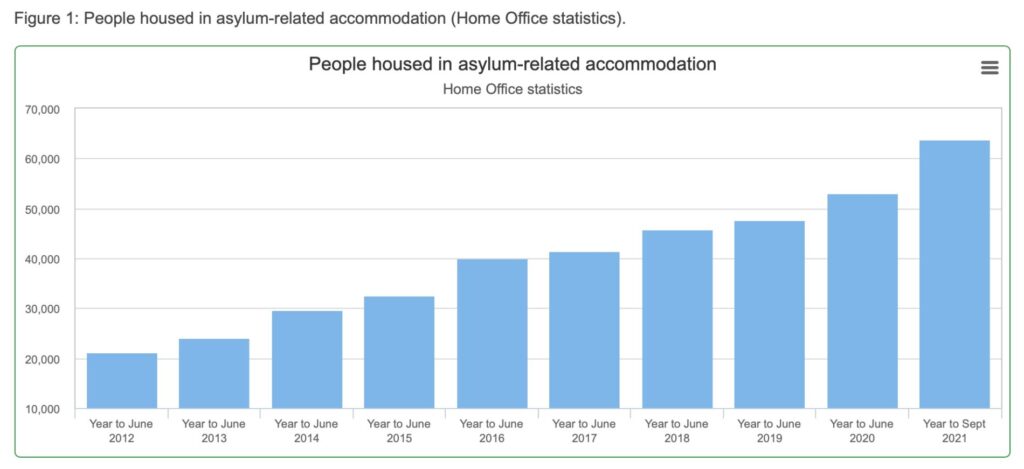
Source: migrationwatchuk.org
Why Is Social Housing Important?
In order to provide an urgent solution to this growing issue, the UK government awarded both Mears Group and Serco Group with £2.9 billion to provide accommodation for asylum seekers. By allocating these social housing funds to housing and property service providers, this sector is expected to transform, improve and strengthen. The new Asylum Accommodation and Support Services Contracts (AASC) were put in place to assist people through the asylum process and provide access to professional support. These new contracts are designed to improve the asylum system in building a higher standard of social housing for vulnerable individuals in the UK. Social housing providers now have a duty to ensure that rigorous maintenance checks are carried out regularly, reporting back any issues to the Home Office once inspections are completed.
Is Social Housing Different From Residential Property?

Generally not. Standard residential houses containing 3 to 4 bedrooms are typically converted into 4 or 5 bedrooms with a downstairs 2nd reception also used as an additional bedroom. This means up to 6 bedrooms can be created whilst maintaining a communal lounge and kitchen. Most properties will contain at least 1 main bathroom and separate WC/shower room. Walking down an average street, it would be impossible to tell if a house was operated as social housing or was owner-occupied or rented privately.
Who Will Manage The Occupants?
Unlike buy to let or HMO properties, the landlord will not deal directly with the occupants. It is in fact the housing provider who will be your ‘corporate tenant’ and you will deal only with them. Your lease agreement and contract are directly with them and they are wholly responsible for the payment of rent to you every month. This contractual commitment applies no matter whether the property is fully occupied, partially occupied or vacant during the term of the lease.
Are There Management Fees?
No. This is one of the major advantages and cost savings when compared to other types of property investment. Management fees are typically 12% including VAT in the UK so you are losing a significant amount from your gross income under this model. Social housing is managed entirely by the provider and no fees are charged to the landlord.
What About Running Costs. Won’t There Be Lots Of Maintenance?
This is one of the distinct advantages of social housing for landlords. Generally speaking day to day internal routine repairs and maintenance are the responsibility of the housing provider including boiler repairs. This means a dramatic saving can be made for all the usual repairs encountered year to year on other types of property investment. It is of course important to read the lease in detail so you understand what responsibilities lie with the landlord (typically structural and external repairs) but these are typically less frequent or common.
Will There Be Any Other Ongoing Costs?
The landlord is responsible for the cost of the annual gas safety certificate (approx. £100) and the 5 yearly electrical safety inspection (approx. £150). These are usually arranged by the housing provider at preferential rates and charged to the landlord for added convenience. You will also need to ensure the building is sufficiently insured as this a requirement of the lease.
What Are The Risks?
The risk for the investor purchasing an already established social housing property relate to the premium they will pay over and above the underlying asset value, much like an HMO. That is to say, the capital value of the property will be determined by the existing rent much like any commercial property (offices, retail etc.). This premium paid when compared to the ‘house next door’ will also take the conversion, development and compliance costs into account.
How Long Is The Lease?
Initial leases with the providers mentioned above are either 5 or 6 years 11 months. There is an option to renew for an additional 3 or 5 years. This effectively means the lease may run for a period of 10 years and possibly beyond if both parties (landlord and provider) wish to do so.
At the end of the agreed lease your property will be returned to you in the condition it was provided, allowing for normal wear and tear. It can then be sold, rented as a buy to let or lived in as you wish.
Can I Re-sell My Property During The Lease?
Yes, you my re-sell the property at any time, just as the current seller may. A new lease will be issued to the new landlord on completion.
Where Can I Buy Social Housing Property?
It would not be difficult search the internet for social housing to buy. However, caution is advised as this is a specialised area of property requiring significant experience to evaluate whether a property represents value and just as importantly, is fully compliant.
You should therefore seek an established, experienced agent familiar with this sector who is able to present you with verified properties and advise on the process from reservation to completion. They will also usually be able to refer you to trusted partners, such as solicitors used to dealing with social housing transactions (many are not) and insurance brokers (property occupied by asylum seekers requires the appropriate insurance).
View Social Housing Examples:
5 Bed Terrace House in Preston
5 Bed Terrace House in St Helens
4 Bed Terrace House in Blackburn
4 Bed Terrace House in Liverpool
4 Bed Terrace House in Nottinghamshire – Coming Soon!
4 Bed Terrace House in Ellesmere Port (near Liverpool) – Coming Soon!
For more examples, please type ‘Social Housing’ on Property Search Bar
Conclusion
With more and more households struggling to cope with huge energy price increases, landlords are becoming increasingly concerned about their tenants’ ability to meet their rent payments in full and on time. Social Housing offers a clear way forward to continue investing, whilst enjoying fixed income rent with no tenant affordability concerns or worries.